 The Goldbach conjecture is fascinating for kids already. One can
understand the statement in elementary school: the conjecture claims that
all even numbers larger than 2 can be written as the sum of two primes. I myself
also learned about the conjecture in middle school in 7th grade. My further
encounters with the Goldbach conjecture appear to fit well into
my "random and silly" online collection, but I also want to see this page also
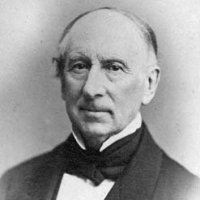
as a contribution to the 300'th birthday of my compatriot Leonard Euler.
Eulers exchanged not only many letters with Goldbach, his work has many
connections with that conjecture.
The Goldbach conjecture is fascinating for kids already. One can
understand the statement in elementary school: the conjecture claims that
all even numbers larger than 2 can be written as the sum of two primes. I myself
also learned about the conjecture in middle school in 7th grade. My further
encounters with the Goldbach conjecture appear to fit well into
my "random and silly" online collection, but I also want to see this page also
as a contribution to the 300'th birthday of my compatriot Leonard Euler.
Eulers exchanged not only many letters with Goldbach, his work has many
connections with that conjecture. What follows are some personal encounters with the conjecture. I'm not a number theorist and never worked on that problem. Anyway, the few mathematical formulas on this page should be accessible on a high school or early college level and - except maybe with the exception of the Cauchy formula - by Euler himself.
Happy birthday, Leonard!
June 2016: Something more about Goldbach in division algebras and for Eisenstein integers.
October 23, 2018: Goldbach comets Mathtable Handout 4 pages [PDF] and Goldbach comet Slides 52 Pages [PDF]
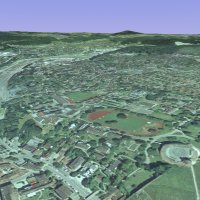 In Highschool the "Kantonsschule Schaffhausen", we had a small, but unusual and
interesting mathematics library which also featured an Olivetti P 6040 computer.
(
In Highschool the "Kantonsschule Schaffhausen", we had a small, but unusual and
interesting mathematics library which also featured an Olivetti P 6040 computer.
(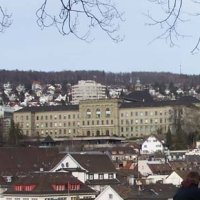 At ETH Zürich, I continued to be mesmerized by computers. The work on the early
Macintosh computers was rather cumbersome: every student had to carry around
large floppies, one with the OS, one with our own stuff. Also the operating system was
impossible. I therefore increasingly liked to work on the Math departments UNIX computer, a
monstrous VAX computer running Ultrix, a variant of Unix. The Unix operating system
fits very well the mathematicians mind, because it is modular, simple and beautiful, like
mathematics. Together with a friend Rolf Kannenberg,
we once occupied the machine to find counter examples to the Goldbach conjecture.
Kannenberg defined the following numbers, which - if he had not called
them already Kannenberg numbers himself - I would now call Kannenberg
numbers: define a function K(p) on the set P of prime numbers as
At ETH Zürich, I continued to be mesmerized by computers. The work on the early
Macintosh computers was rather cumbersome: every student had to carry around
large floppies, one with the OS, one with our own stuff. Also the operating system was
impossible. I therefore increasingly liked to work on the Math departments UNIX computer, a
monstrous VAX computer running Ultrix, a variant of Unix. The Unix operating system
fits very well the mathematicians mind, because it is modular, simple and beautiful, like
mathematics. Together with a friend Rolf Kannenberg,
we once occupied the machine to find counter examples to the Goldbach conjecture.
Kannenberg defined the following numbers, which - if he had not called
them already Kannenberg numbers himself - I would now call Kannenberg
numbers: define a function K(p) on the set P of prime numbers as
 We programmed the VAX to find out how fast K(p) should grow and
let it run for days. Because we needed arbitrary large integer arithmetic, we used the
programming language Cayley, a computer algebra system which was
later renamed Magma. The experiments confirmed that the Kannenberg numbers seemed to grow
exponentially fast, that the chance of having K(p)>p appeared slimmer and slimmer as
longer as the jobs were running. Unfortunately, our latest run got lost: after a few days, we got
angry emails from the system administrator: our program had burned 30'000 Swiss Franks of CPU time
into their IT budget. Our batch job got killed. This was the end of our Goldbach
conjecture adventure. The sequence of numbers 6,12,30,98,220, ... is today known as the
Sloane sequence
We programmed the VAX to find out how fast K(p) should grow and
let it run for days. Because we needed arbitrary large integer arithmetic, we used the
programming language Cayley, a computer algebra system which was
later renamed Magma. The experiments confirmed that the Kannenberg numbers seemed to grow
exponentially fast, that the chance of having K(p)>p appeared slimmer and slimmer as
longer as the jobs were running. Unfortunately, our latest run got lost: after a few days, we got
angry emails from the system administrator: our program had burned 30'000 Swiss Franks of CPU time
into their IT budget. Our batch job got killed. This was the end of our Goldbach
conjecture adventure. The sequence of numbers 6,12,30,98,220, ... is today known as the
Sloane sequence
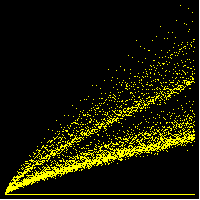
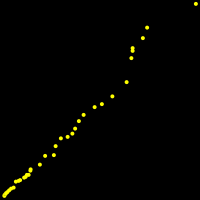 Here are the first Kannenberg numbers.
The number 98 for example is the first even number for which n-3,n-5,n-7 are all not prime.
It is also the smallest even number for which n-3,n-5,n-7,n-11,n-13,n-17 is not prime, but then
220 is the first even number for which n-3,n-5,n-7,n-11,n-13,n-17,n-19
are all not prime:
Here are the first Kannenberg numbers.
The number 98 for example is the first even number for which n-3,n-5,n-7 are all not prime.
It is also the smallest even number for which n-3,n-5,n-7,n-11,n-13,n-17 is not prime, but then
220 is the first even number for which n-3,n-5,n-7,n-11,n-13,n-17,n-19
are all not prime:
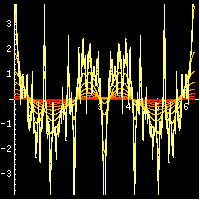 My stay at Caltech had been an exciting time: Barry Simon had just launched an ambitious and
extensive program of investigating singular continuous spectral properties of Schroedinger
operators. I had become interested in Schroedinger operators as a graduate student because they appear as
"Jacobeans" in twist dynamical systems. The theory also applies to Koopman operators in
ergodic theory. In any case, spectral properties are closely related to dynamical properties
of the systems. I'm still happy that I could witness and contribute a tiny bit to this developments.
Before leaving from California to the university of Arizona, I briefly became interested in the "prime measure",
the pseudo measure m which has the Fourier transform c(n) = 1P(n), where P is the
set of prime numbers. This is a rather singular object because for an absolutely continuous measure,
the Fourier transform decays and for a discrete measure, the Fourier transform is almost periodic.
Is it accessible by Fourier theory? My diary shows that I worried then, how much of the theory for
Hausdorff measures carries over to pseudo measures.
My stay at Caltech had been an exciting time: Barry Simon had just launched an ambitious and
extensive program of investigating singular continuous spectral properties of Schroedinger
operators. I had become interested in Schroedinger operators as a graduate student because they appear as
"Jacobeans" in twist dynamical systems. The theory also applies to Koopman operators in
ergodic theory. In any case, spectral properties are closely related to dynamical properties
of the systems. I'm still happy that I could witness and contribute a tiny bit to this developments.
Before leaving from California to the university of Arizona, I briefly became interested in the "prime measure",
the pseudo measure m which has the Fourier transform c(n) = 1P(n), where P is the
set of prime numbers. This is a rather singular object because for an absolutely continuous measure,
the Fourier transform decays and for a discrete measure, the Fourier transform is almost periodic.
Is it accessible by Fourier theory? My diary shows that I worried then, how much of the theory for
Hausdorff measures carries over to pseudo measures.
 Powerful tools to transform a problem into a different problem form the backbone of
mathematics. Examples are
Powerful tools to transform a problem into a different problem form the backbone of
mathematics. Examples are  Assume we could find a sequence an such that
 An example: if a(n) = -log(1-1/ns), then with z=r ei p x
 Finding a sequence an, for which the Fourier coefficients of
f2 can be estimated, is a trick called the "circle method" discovered by
Hardy and Littlewood. For bounded sequences an like an,
the function
Finding a sequence an, for which the Fourier coefficients of
f2 can be estimated, is a trick called the "circle method" discovered by
Hardy and Littlewood. For bounded sequences an like an,
the function
 The Goldbach conjecture states that all even derivatives of
the function f2(z) are nonzero at the origin.
Assume, there was a function for which the roots and an explicit formula
The Goldbach conjecture states that all even derivatives of
the function f2(z) are nonzero at the origin.
Assume, there was a function for which the roots and an explicit formula
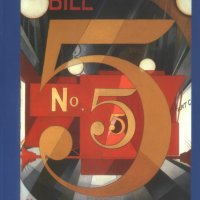 In 2004, a multi-variable student of mine Jose Ramirez told me
about the book "Uncle Pedros and the Goldbach conjecture" by
Apostolos Doxiadis.
In 2004, a multi-variable student of mine Jose Ramirez told me
about the book "Uncle Pedros and the Goldbach conjecture" by
Apostolos Doxiadis. 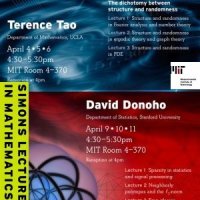 In his first Simons lectures at MIT in April 2007 for a general audience, which I watched,
Terence Tao was asked, whether he believes that the Goldbach conjecture
is true: Tao: "Did you ask, whether I think a proof will be found or
whether it is true?" Audience: "Whether it is true". Tao:
"Of course it is true! The numerical evidence is overwhelming."
Tau's talk mentioned the Goldbach conjecture together with the twin prime
conjecture and the
In his first Simons lectures at MIT in April 2007 for a general audience, which I watched,
Terence Tao was asked, whether he believes that the Goldbach conjecture
is true: Tao: "Did you ask, whether I think a proof will be found or
whether it is true?" Audience: "Whether it is true". Tao:
"Of course it is true! The numerical evidence is overwhelming."
Tau's talk mentioned the Goldbach conjecture together with the twin prime
conjecture and the
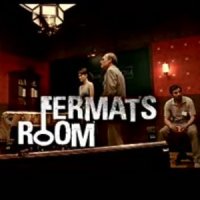 Added in July 2009: one of the wonderful things of collecting things online is that readers
can give input. In July 2009, Evan Pellnitz suggested to me by email the movie "Fermat's room".
I could only order the Spanish version (other region code) but it was worth the trouble. The thriller is
fantastic evenso the math riddles are quite standard and well known. You find the start of the movie
Added in July 2009: one of the wonderful things of collecting things online is that readers
can give input. In July 2009, Evan Pellnitz suggested to me by email the movie "Fermat's room".
I could only order the Spanish version (other region code) but it was worth the trouble. The thriller is
fantastic evenso the math riddles are quite standard and well known. You find the start of the movie
![[Book cover scan]](vinogradov/01.jpg)
![[1 (blue handwriting by Kannenberg)]](diary/tagebuch1.jpg)
![[2]](diary/tagebuch2.jpg)

![[bookcover]](vinogradov/02.jpg)