Gaussian Primes
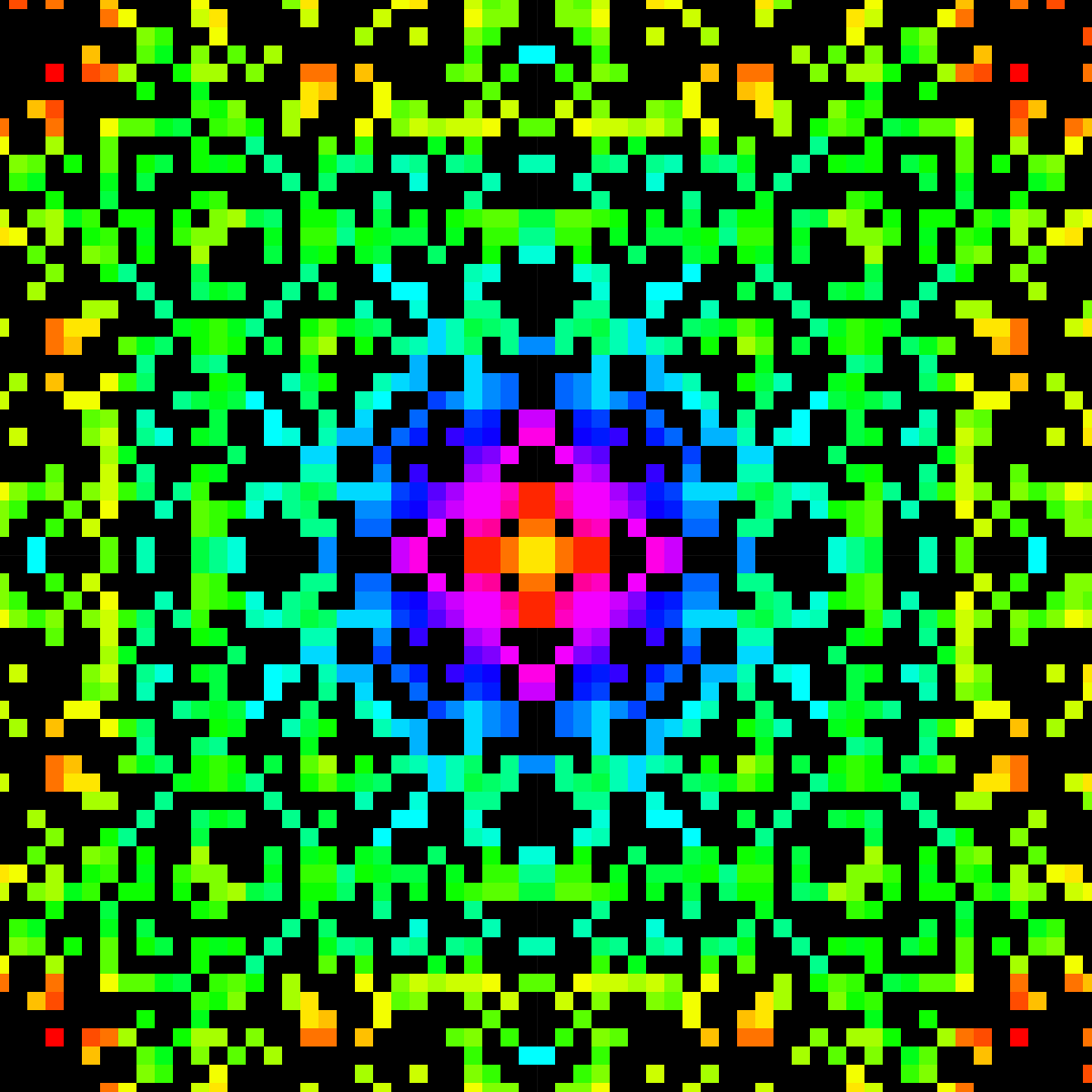
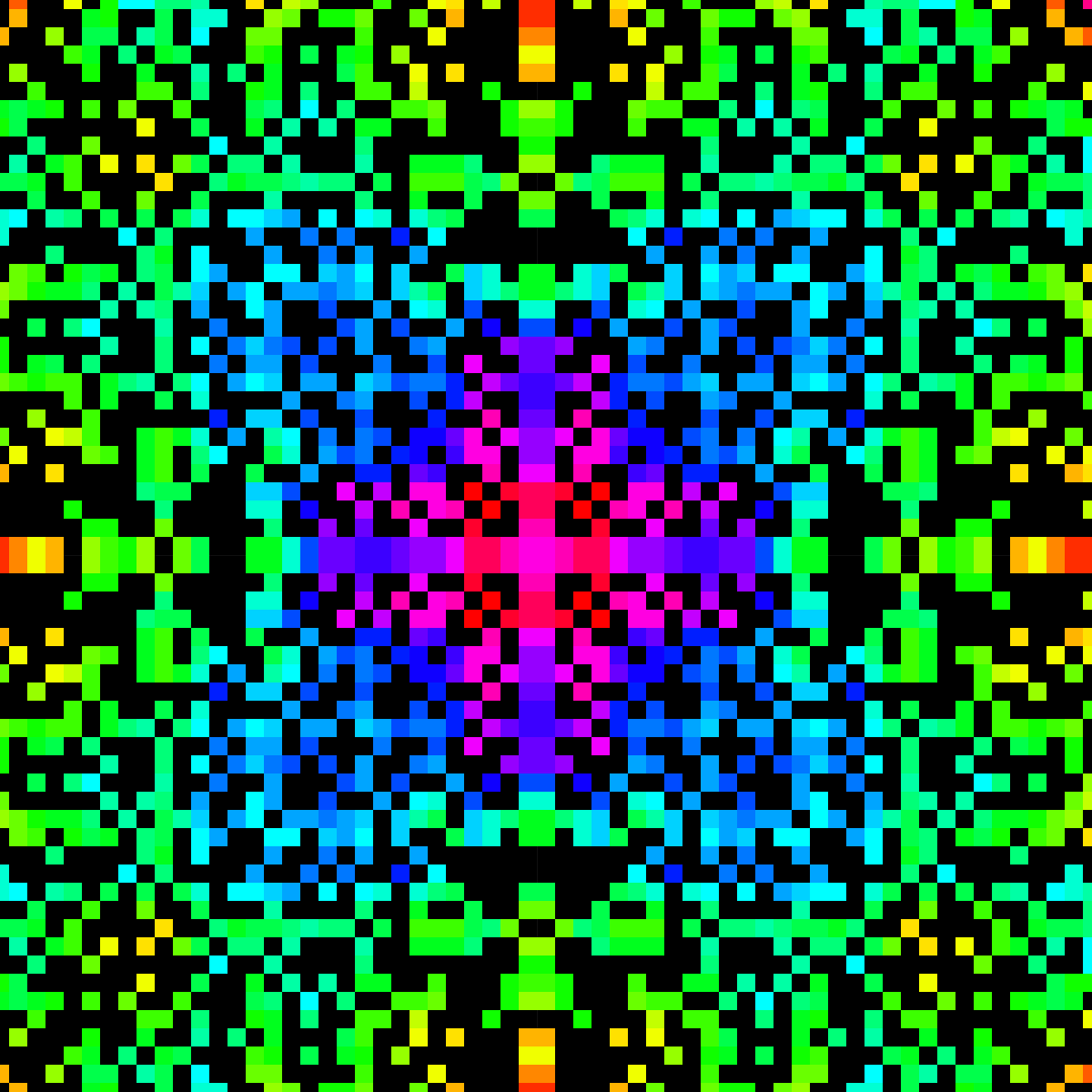
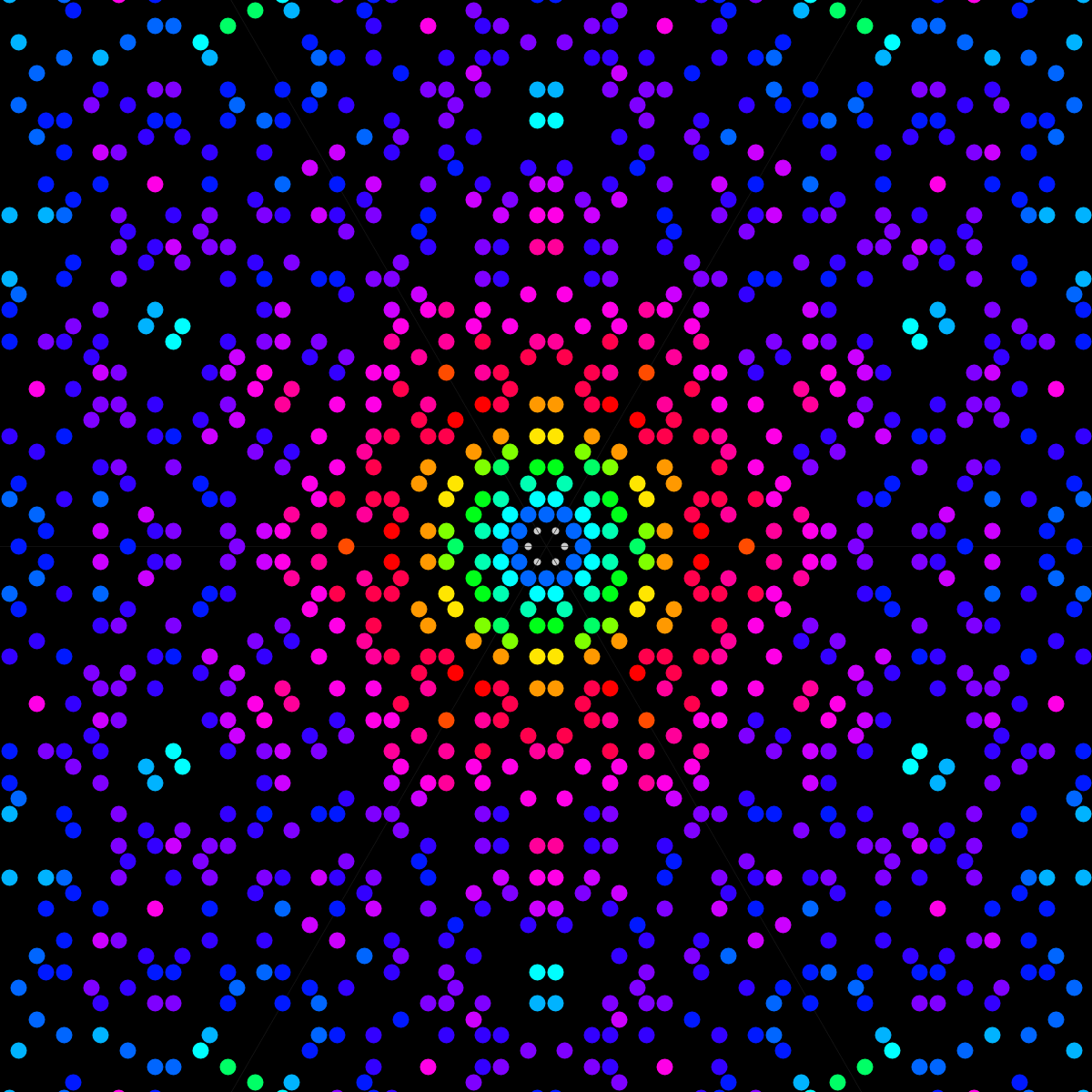
These are pictures from the paper. The first shows the primes near
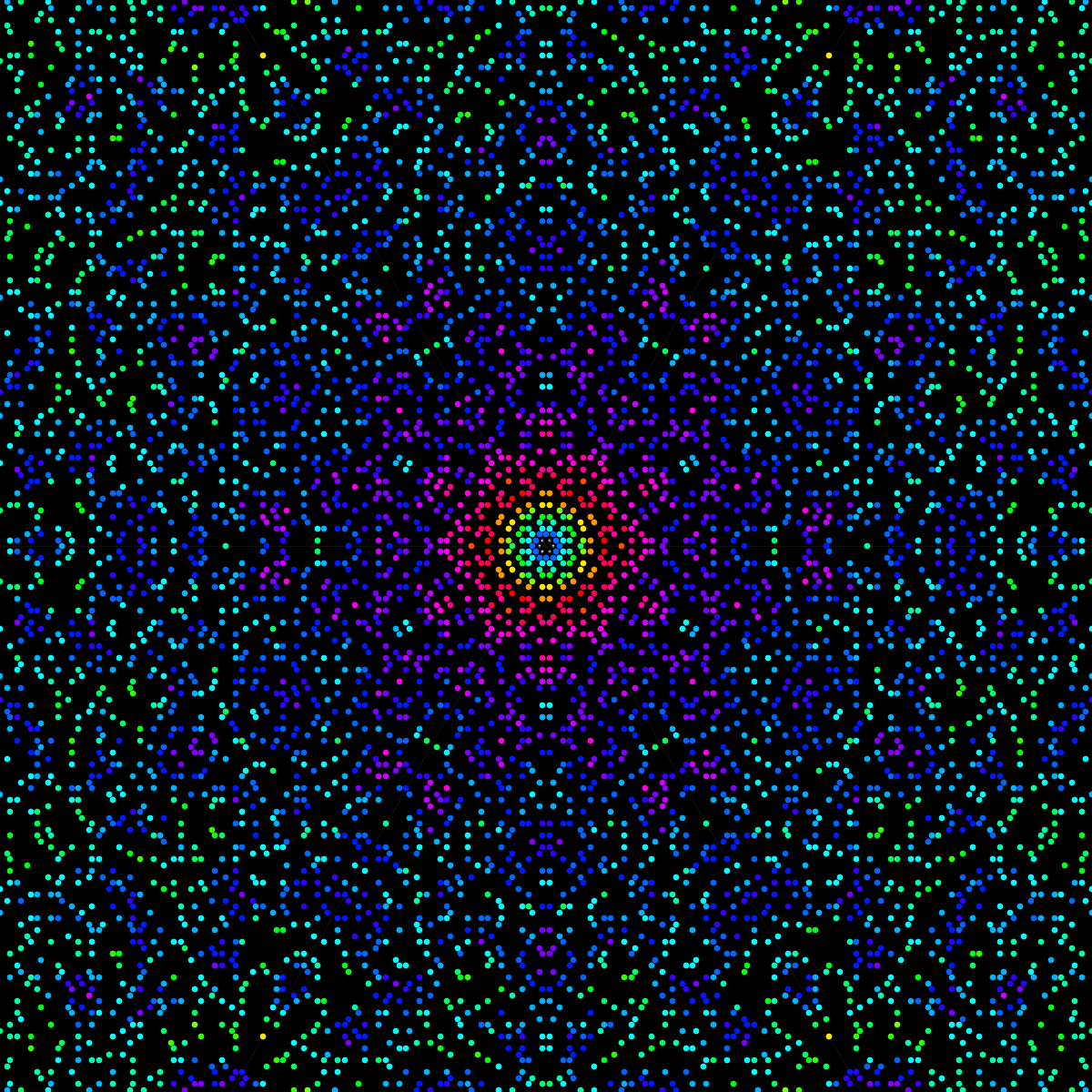
the origin. The second picture is a bit more out. There are three
type of primes z=a+ib. We write N(z)=a
2 + b
2.
There are the primes belonging to p=N(z)=2, which are already
a ramified situation, then there are the primes on the real and imaginary
axes, which belong to rational 4k-1 primes p=(N(z))
1/2,
then there are the rest, which belong to the 4k+1 primes p=N(p).
For the later, there are eight species for each prime.
The
orbifold picture, in which the dihedral discrete symmetry is factored out reveals the structure better and also shows how the
two different situations shuffle the primes as half of them need the square root of N(z) rather than N(z).
Eisenstein Primes
The Eisenstein primes are even more attractive due to their hexagonal
symmetry. There are again three type of primes which again
the orbifold picture shows better: there are primes
z=a+w b with p=a
2 + b
2 + a b
belonging to rational primes p satisfying p=0,1 modulo 3, or then
primes belonging to primes z where p
1/2 satisfies p=2 modulo 3.
Note that in our Goldbach setup, we chose to use w=(1+(-3)
1/2)/2
rather than w=(1-(-3)
1/2)/2. Traditionally, the later, the cube
root of 1 is taken. We take the cube root of -1, which is of course, due to the symmetry completely equivalent. But we have then also N(z)
= a
2 + ab+ b
2 rather than the version with the
different sign seen in most books. We see again the very close neighborhood
and the zoom out a bit. Arn't they not gorgeous?
Hurwitz Primes
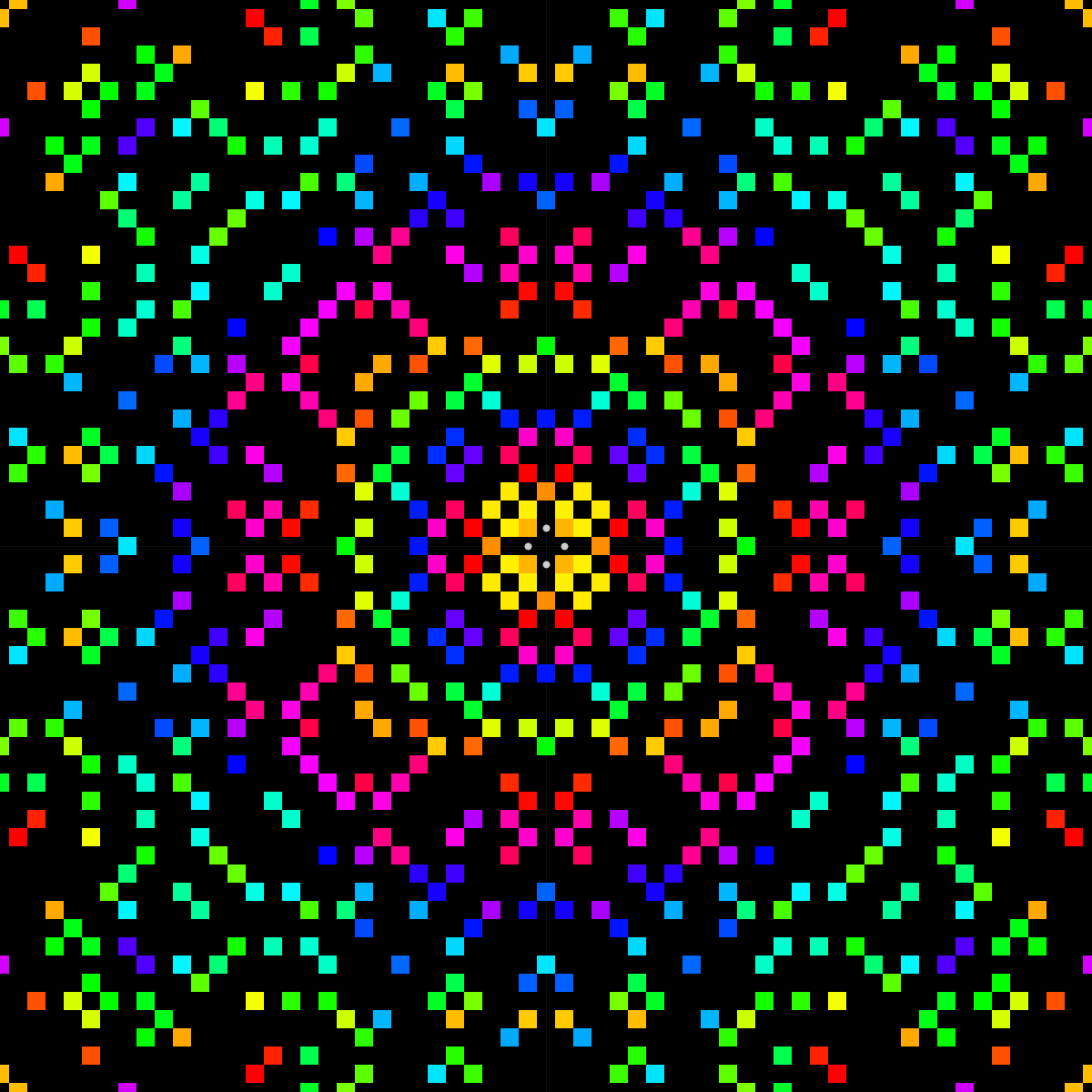
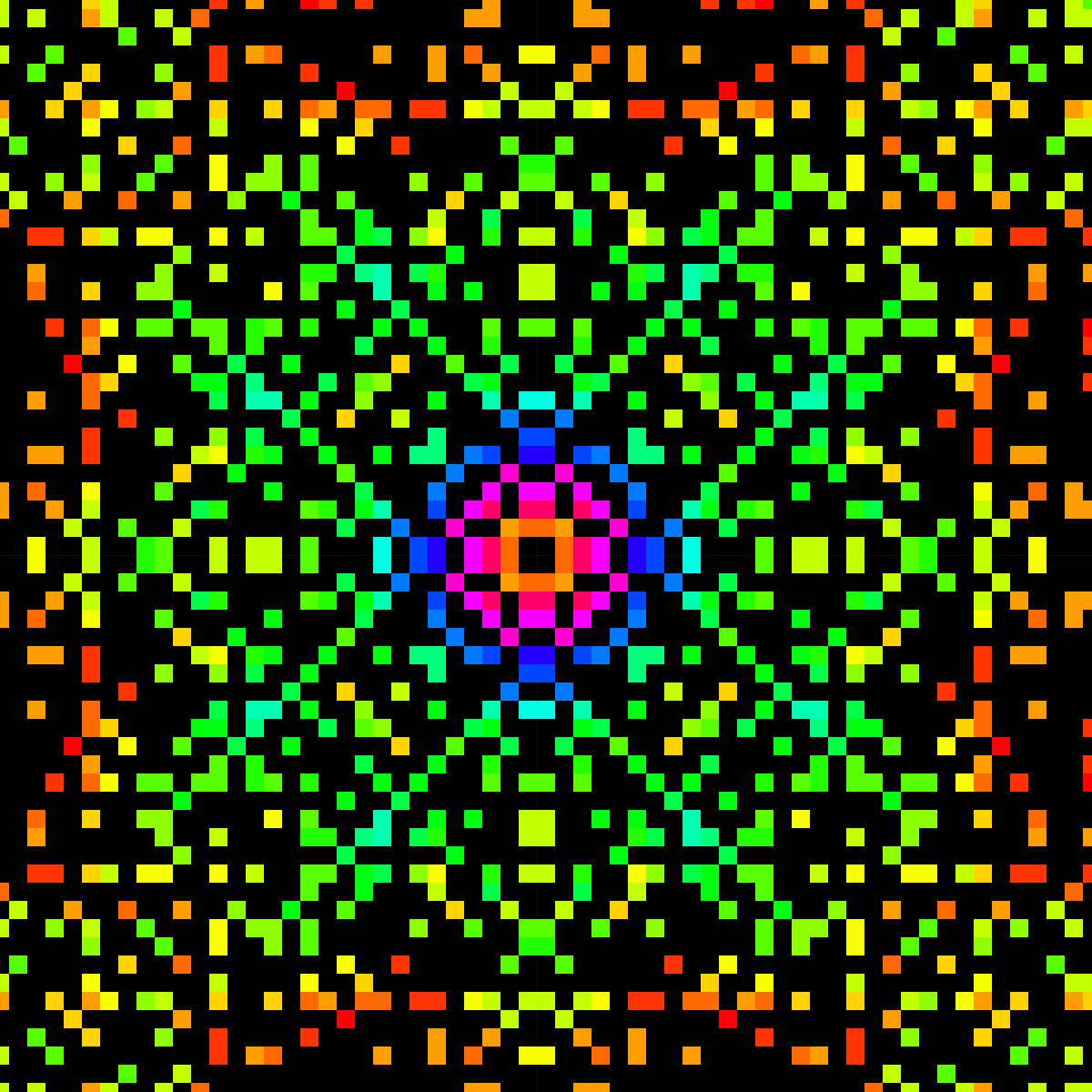
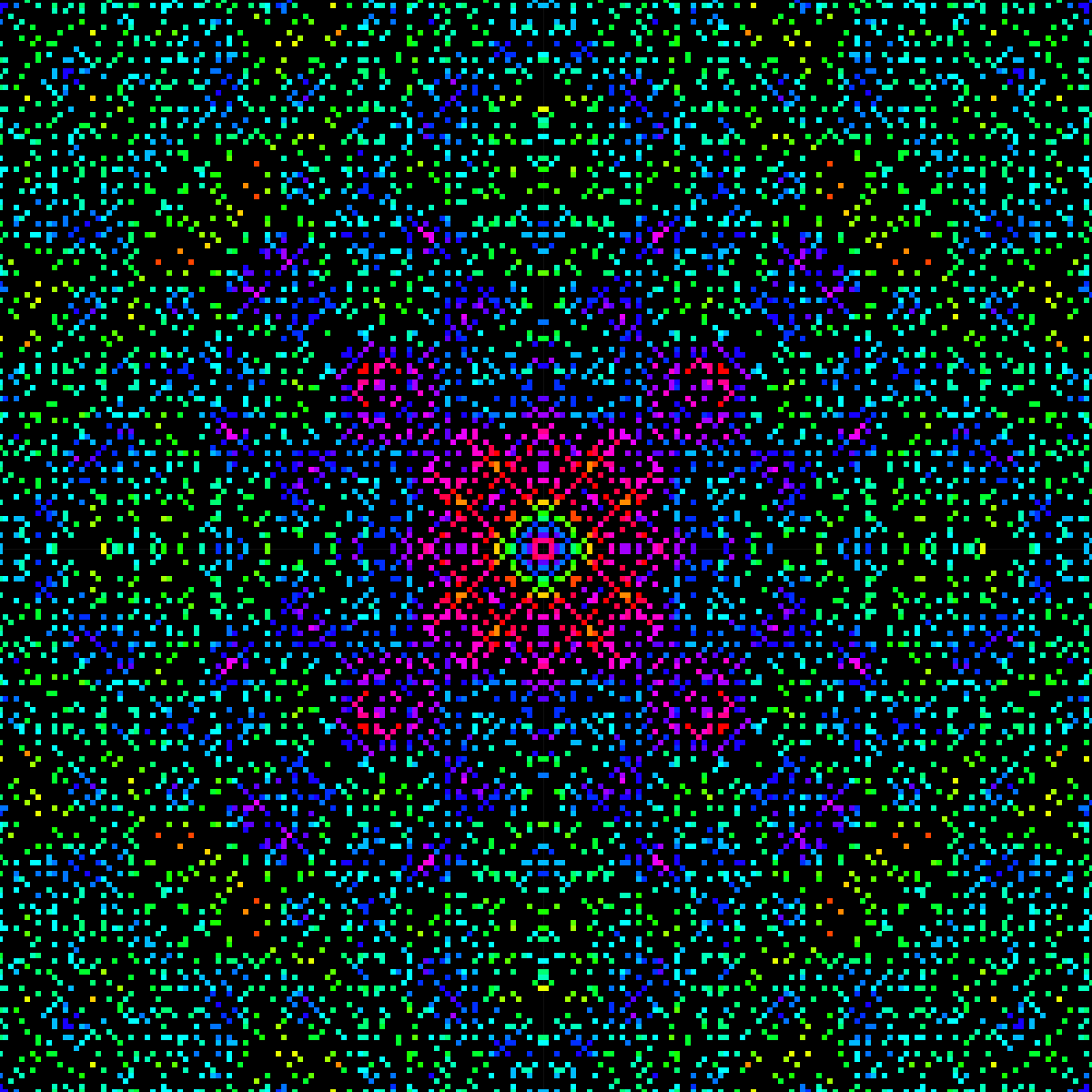
I'm not aware that anybody has shown pictures of Hurwitz primes.
Of course, since they live in four dimensional space, we have to
take slices. We can either take three dimensional slices
(See
3D Prime slices), or then cut through
two dimensional planes. The following pictures do that.
You can also look at an
Animation
showing what happens if you move away from the origin. If these pictures
here are "home", then in the animation, we move away to distance 10
100. Note that our visible universe is about 10
26 cm long only.
Octavian Primes
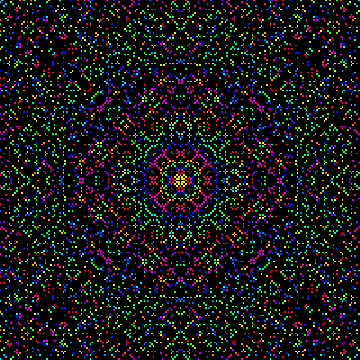
And finally, here are some pictures of Octavian primes. They live in 8 dimensional space. Again, we slice through two dimensional planes. They appear even denser which makes us confident that an Octavian Goldbach conjecture should hold. We refused still to write it as a conjecture for two reasons: we have not made enough experiments. And second, more importantly, we don't know whether it is a difficult problem. While for the three other cases, (Gaussian, Eisenstein, Hurwitz), we can relate to difficult Bunyakovsky, Landau type problems which are believed to be hard, this is not yet done here.